Congressional Gold Medal for those of Italian Lineage
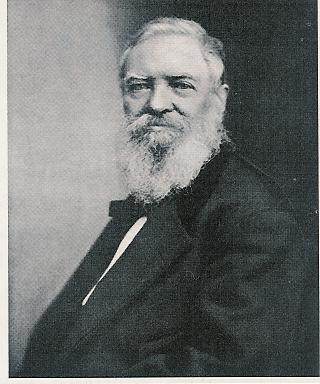
Umberto Nobile
From Wikipedia, the free encyclopedia
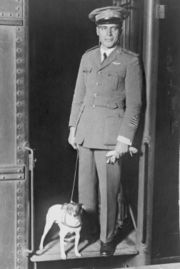
Umberto Nobile (1926)
Umberto Nobile (January 21, 1885 – July 30, 1978) was an Italian aeronautical engineer and Arctic explorer. Nobile was a developer and promoter of semi-rigid airships during the Golden Age of Aviation between the two World Wars. He is primarily remembered for designing and piloting the airship Norge, which may have been the first aircraft to reach the North Pole, and which was indisputably the first to fly across the polar ice cap from Europe to America. Nobile also designed and flew the Italia, a second polar airship; this second expedition ended in a deadly crash and provoked an international rescue effort.
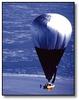
Benjamin L. Abruzzo (June 9, 1930 – February 11, 1985) was an American hot air balloonist and businessman. He helped place Albuquerque on the map as the balloon capital of the world. Abruzzo was born in Rockford. He graduated from the University of Illinois in 1952, and then entered the United States Air Force. After graduation, Abruzzo was stationed at Kirtland Air Force Base in New Mexico. He would adopt New Mexico as his home state after leaving military service in 1954. Abruzzo took an interest in hot air ballooning. He was on the crew of the Double Eagle I in 1977. After the five deaths in the early 1970s, many believed the Double Eagle I would become the first balloon to cross the Atlantic Ocean. Unfortunately, Abruzzo suffered exposure and frostbite while over Iceland and was forced to abandon the attempt. The team, this time with Maxie Anderson and Larry Newman, made a second attempt in the Double Eagle II in 1978. The team took off from Presque Isle, Maine on August 11 and made a successful landing in Miserey, France six days later. For their efforts, the team was awarded the Congressional Gold Medal in 1979. Abruzzo was also on the Double Eagle V team. The Double Eagle V was the first team to cross the Pacific Ocean in a gas balloon in November 1981. This flight also set a record for longest trip by a team in a balloon. Abruzzo died a few years later when his private plane crashed near Albuquerque. His name lives on in the new Anderson-Abruzzo Albuquerque International Balloon Museum in Albuquerque. His son, Richard, is also a noted balloonist who continues to fly today.
Frank Sinatra
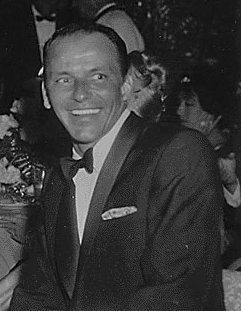
Frank Sinatra in 1960
Francis Albert "Frank" Sinatra (December 12, 1915 – May 14, 1998) was an American singer and actor. Beginning his musical career in the swing era with Harry James and Tommy Dorsey, Sinatra became a successful solo artist in the early to mid-1940s, being the idol of the "bobby soxers." His professional career had stalled by the 1950s, but it was reborn in 1954 after he won the Academy Award for Best Supporting Actor. He signed with Capitol Records and released several critically lauded albums (such as In the Wee Small Hours, Songs for Swingin' Lovers, Come Fly with Me, Only the Lonely and Nice 'n' Easy). Sinatra left Capitol to found his own record label, Reprise Records (finding success with albums such as Ring-A-Ding-Ding, Sinatra at the Sands and Francis Albert Sinatra & Antonio Carlos Jobim), toured internationally, was a founding member of the Rat Pack and fraternized with celebrities and presidents, including President John F. Kennedy. Sinatra turned 50 in 1965, recorded the retrospective September of My Years, starred in the Emmy-winning television special Frank Sinatra: A Man and His Music, and scored hits with "Strangers in the Night" and "My Way".
Sinatra attempted to weather the changing tastes in popular music, but with sales of his music dwindling, and after appearing in several poorly received films, he retired in 1971. Coming out of retirement in 1973, he recorded several albums; scored a Top 40 hit with "(Theme From) New York, New York" in 1980; and toured both within the United States and internationally until a few years before his death in 1998. Sinatra also forged a career as a dramatic actor, winning the Academy Award for Best Supporting Actor for his performance in From Here to Eternity, and he was nominated for the Academy Award for Best Actor for The Man with the Golden Arm. He also starred in such musicals as High Society, Pal Joey, Guys and Dolls and On the Town. Sinatra was honored at the Kennedy Center Honors in 1983 and was awarded the Presidential Medal of Freedom by Ronald Reagan in 1985 and the Congressional Gold Medal in 1997. Sinatra was also the recipient of eleven Grammy Awards, including the Grammy Trustees Award, Grammy Legend Award and the Grammy Lifetime Achievement Award.
Constantino Brumidi
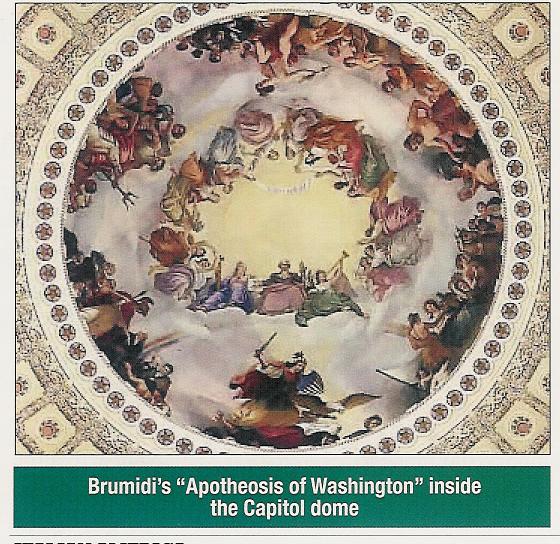
 Brumidi's fresco, Apotheosis of Washington adorns the underside of the dome in the rotunda of the United States Capitol
Constantino Brumidi (July 26, 1805 – February 19, 1880) was an Italian/Greek-American historical painter, best known and honored for his fresco work in the Capitol Building in Washington, DC. Brumidi was born in Rome, the son of Stavro Broumidi[1] (Stavros Broumides in Greek), a native of Filiatra (in western Messinia, a district in the Peloponnesos, a region in southern Greece). His mother was from Rome. He showed his talent for fresco painting at an early age and painted in several Roman palaces, among them being that of Prince Torlonia. Under Gregory XVI he worked for three years in the Vatican. The occupation of Rome by French forces in 1849 apparently persuaded Brumidi to emigrate, having joined the short-lived risorgimental Roman Republic, and he sailed for the United States, where he became a naturalized citizen in 1852. Taking up his residence in New York City, the artist painted a number of portraits. Subsequently he undertook more important works, the principal being a fresco of the Crucifixion in St. Stephen's Church, for which he also executed a Martyrdom of St. Stephen and an Assumption of Mary. He also executed frescoes at Taylor's Chapel, Baltimore, Maryland.In 1854 Brumidi went to Mexico, where he painted an allegorical representation of the Holy Trinity in the Mexico City cathedral. On his way back to New York he stopped at Washington D.C. and visited the Capitol. Impressed with the opportunity for decoration presented by its vast interior wall spaces, he offered his services for that purpose to Quartermaster General Montgomery C. Meigs. This offer was accepted, and about the same time he was commissioned as a captain of cavalry. His first art work in the Capitol Building was in the meeting room of the House Committee on Agriculture. At first he received eight dollars a day, which Jefferson Davis, then Secretary of War of the United States, caused to be increased to ten dollars. His work attracting much favourable attention, he was given further commissions, and gradually settled into the position of a Government painter. His chief work in Washington was done in the rotunda of the Capitol and included the Apotheosis of George Washington in the dome, as well as other allegories, and scenes from American history. His work in the rotunda was left unfinished at his death, but he had decorated many other sections of the building, most notably hallways in the Senate side of the Capitol now known as the Brumidi Corridors. In the Cathedral-Basilica of Sts. Peter and Paul in Philadelphia, Pennsylvania, he pictured St. Peter and St. Paul. Brumidi was a capable, if conventional painter, and his black and white modeling in the work at Washington, in imitation of bas-relief, is strikingly effective. He decorated the entrance hall of Saleaudo, located at Frederick, Maryland, and listed on the National Register of Historic Places in 1979.[1] He died in Washington, DC
John Basilone
November 4, 1916 – February 19, 1945 (aged 28)
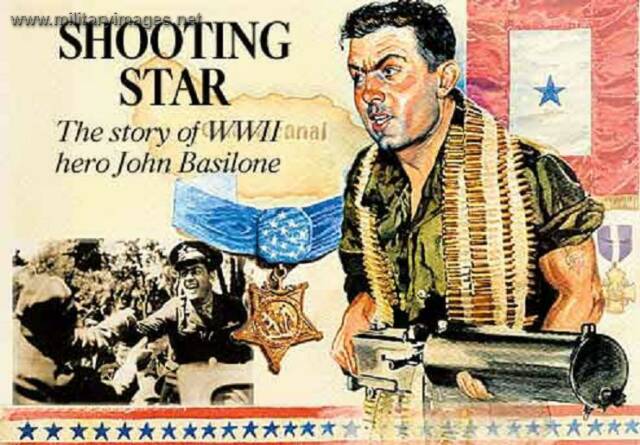
John Basilone in his Marine Corps uniform lower left corner
Nickname"Manila John"
"Manila John"Place of birth Buffalo, New York
Place of deathIwo Jima, KIA
Iwo Jima, KIA Place of burialArlington National Cemetery
Arlington National Cemetery Allegiance United States of America Service/branch United States Marine Corps
Years of service1934-1937 (U.S. Army) 1940-1945 (USMC)
1934-1937 (U.S. Army) 1940-1945 (USMC)Rank Gunnery Sergeant Unit1st Battalion, 7th Marines Battles/warsWorld War II
Gunnery Sergeant Unit1st Battalion, 7th Marines Battles/warsWorld War II*Battle of Guadalcanal, *Battle of Iwo Jima AwardsMedal of Honor, Navy Cross and Purple Heart
Medal of Honor, Navy Cross and Purple Heart Gunnery Sergeant John Basilone (November 4, 1916 – February 19, 1945) was a United States Marine who was awarded the Medal of Honor for his actions at the Battle of Guadalcanal during World War II. He was the only enlisted Marine in World War II to receive the Medal of Honor and the Navy Cross, as well as a Purple Heart.
[1]He held off 3,000 Japanese troops at Guadalcanal, after his 15-member unit was reduced to two men.
[2] Basilone was killed in action on the first day of the Battle of Iwo Jima, after which he was posthumously honored with the Navy Cross.
Basilone is buried in Arlington National Cemetery. In April 2007, it was announced that Basilone's deeds, along with Robert Leckie's memoirs, Helmet for My Pillow, and Eugene B. Sledge's book With the Old Breed, would form the basis for the HBO series The Pacific, the successor to Band of Brothers.